WSOP Main Event Attendance Is Falling. It's Not Who You Think.
The World Series of Poker just wrapped a record-breaking summer, ESPN is back with more Main Event programming than it has aired in years, and the final table plays out today through Wednesday. Live poker, by every headline measure, is booming.
And yet WSOP Main Event attendance tells a different story. The field has shrunk for a second straight year. The American contingent has shrunk for a third, every year since its 2023 peak. Both things are true at once: a thriving series, and a flagship event quietly losing the customers it was built on.
When Dave Woods ran "2026 World Series of Poker by the numbers" at Poker.org — amongst the good news of 251,899 entries across the series, an all-time record — one line stuck with me: the Main Event shrank again. I wanted to know who stopped coming. So I analyzed player-level records, nine years of them, assembled from PokerNews' published chip counts and matched player by player.
What the data shows is that the record-breaking series and the shrinking Main Event aren't a contradiction—they're driven by two different customer bases. The series grows on volume: more events, more re-entries, more of everything. The Main Event, meanwhile, has been sustained by its loyal regulars even as the pipeline of new American players that once fed it steadily dries up.
How We Counted WSOP Main Event Attendance
Everything in this piece comes from one dataset: 60,399 player-level records of WSOP Main Event attendance, built from PokerNews' published end-of-day chip counts across the nine Series from 2017 to 2026 (2020 was online-only and is excluded by design; 2017's partial coverage is excluded from the country analysis).
PokerNews is the Main Event's live-reporting infrastructure: at the end of every Day 1 flight it publishes a table of players — names, countries, chip counts. I collected those lists for every year and matched the same person across years, the way a shop recognizes a repeat customer. For most players — about 83% — there's no guesswork involved, because coverage links each of them to their own unique player page; the rest are matched by name and country. That's how the dataset can tell a returning player from a first-timer, which no field-size total can do.
The lists don't catch everyone. They capture roughly 8 out of every 10 entrants in a given year — but that catch rate is steady across all nine years, so the counts scale up cleanly to official field sizes and, more importantly, the trends are reliable even where any single year's exact figure carries some uncertainty.
I used Claude (Anthropic's Fable 5 model) to help assemble, process, and analyze the records, and every published number was then re-derived in an independent audit pass before this piece went up. Every method has limits, and this one's are laid out in full — matching tiers, coverage rates by year, country tables, exclusions, known limitations, and downloadable data tables — on a separate page (link below).
Who Stopped Coming
American attendance did not collapse between 2018 and 2026 — it flatlined. In 2018, an estimated ~5,500 Americans played the Main Event. In 2026 it was ~5,500 again, keeping the curve essentially flat across eight years.
American attendance surged to roughly 6,500 in 2023 on the post-COVID wave, then declined each year afterward, falling about 15% from that peak by 2026. Zooming out, however, the longer-term trend doesn't look like a collapse—it looks like stagnation. The American field remained essentially flat for a decade while the rest of the world grew, followed by a one-year post-pandemic surge that, at the time, looked like the start of sustained growth.
International attendance, the other half of the picture, went the opposite direction: up roughly 35–55% between 2018 and 2026, depending on your baseline year, peaking in 2025.
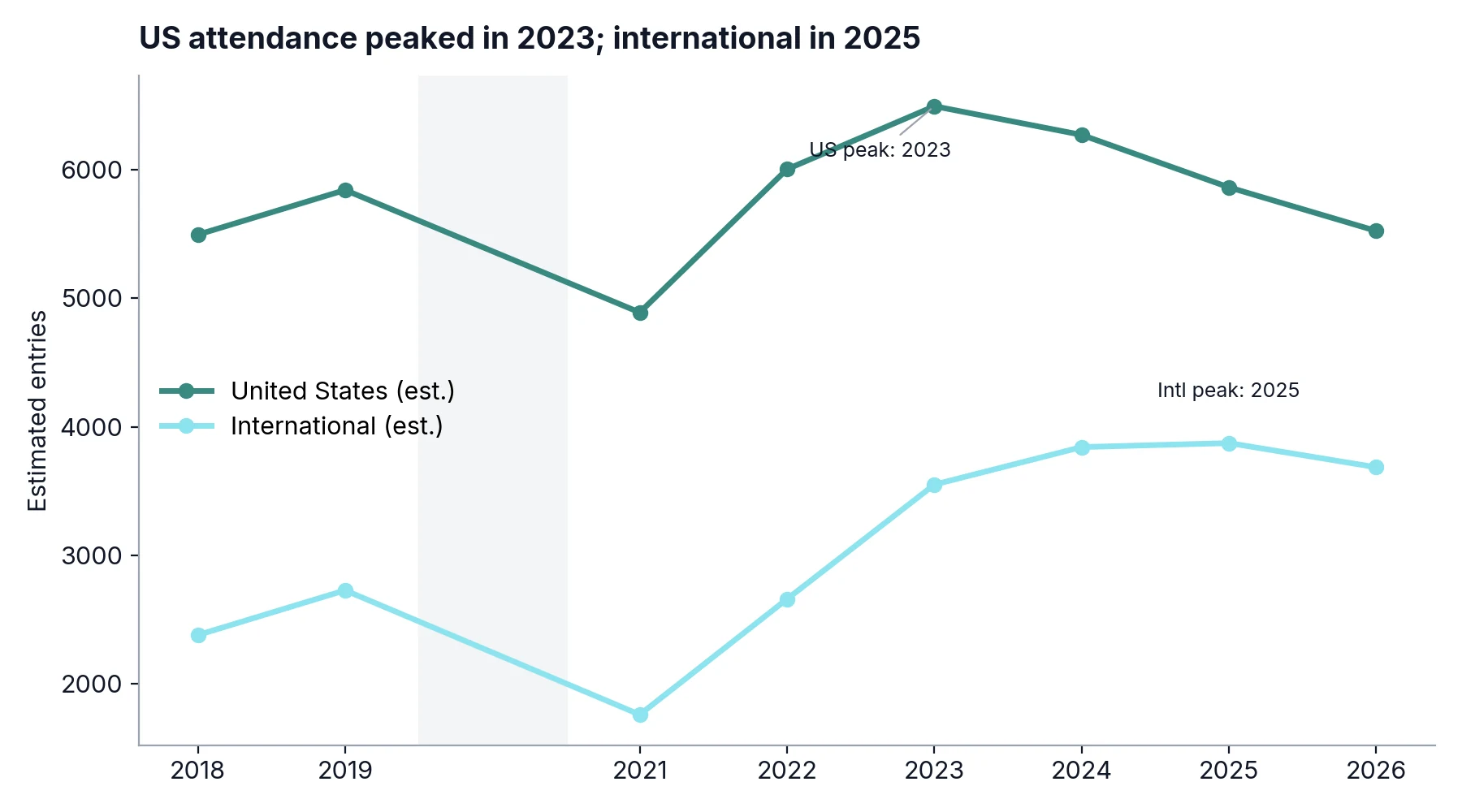
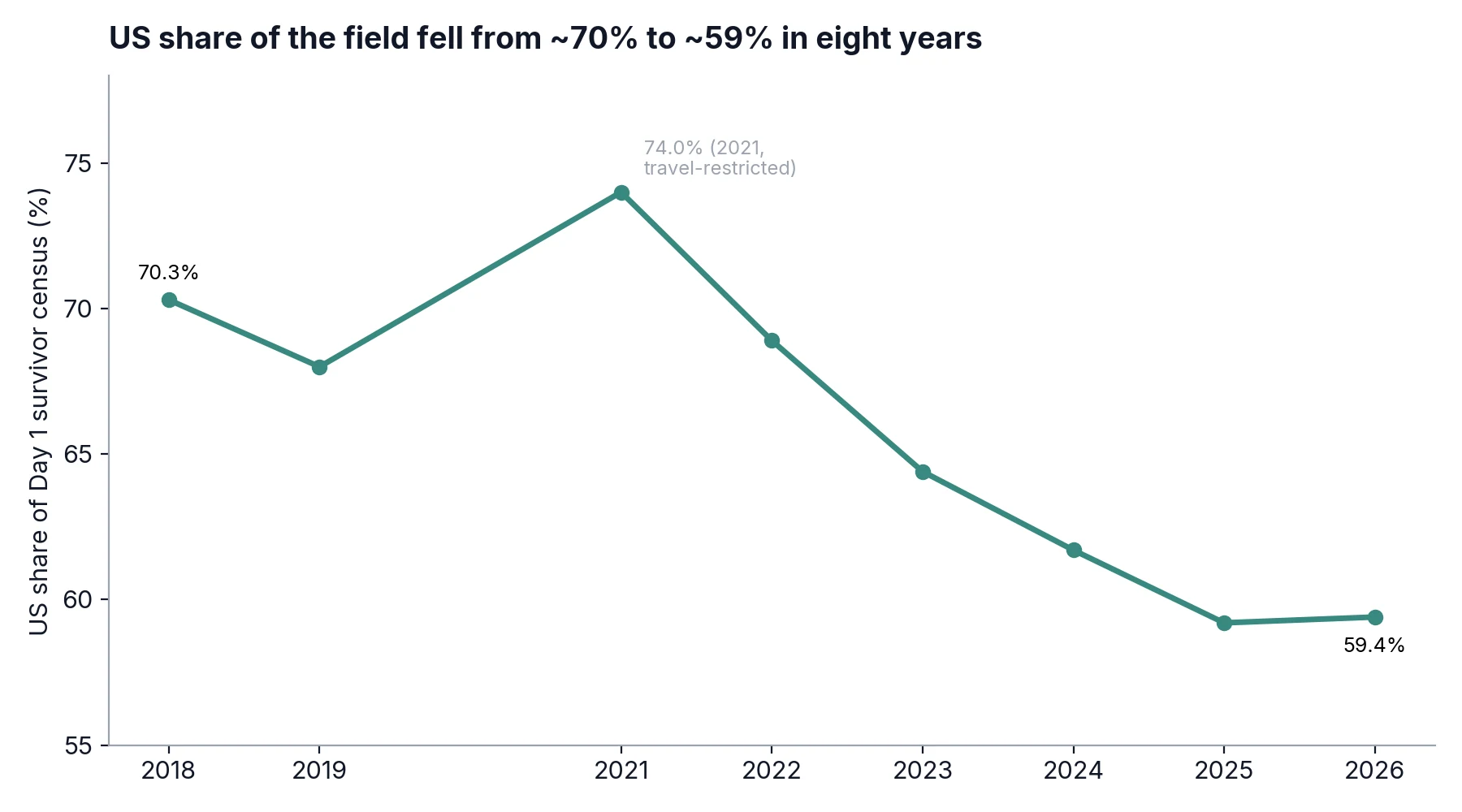
Put the two lines together and you get the composition shift that field-size totals hide. The US share of the field slid from 70.3% in 2018 to 59.4% in 2026 — an eleven-point drop in eight years. The Main Event is still an American-majority event. But as the data makes clear, the balance is beginning to shift.
Where did the growth come from? Nearly everywhere outside North America. Japan is the standout: up 282% over the window, from ~50 players to ~192 — nearly quadrupling. Argentina grew 268%, China 184%, Spain 156%. France added more players than any other European country (+141, a statistical tie with Japan for the most of any country) and hit its all-time high in 2026. The United Kingdom, Brazil, Israel, South Korea, and Mexico all posted solid gains in player participation.
The losers' column is short. Canada is down about 70 players over the full window. Russia fell from the top tier after 2019 and never recovered its peak — roughly 55 Russians still played in 2026, but the country dropped out of the top 15.
North America peaked in 2023 and has fallen hardest, the other established Anglophone markets (UK, Australia) peaked in 2024–25 and pulled back double digits, while the growth markets barely retreated at all — Japan, Argentina, and Brazil sit within about 10–12% of their 2025 peaks, and France, Spain, Israel, and Mexico all set new highs in 2026. The 2024-to-2025 field decline was entirely American — international attendance actually rose that year. Only in 2026 did both halves of the field shrink simultaneously — possibly a signature of broader global turmoil weighing on discretionary spending.
American attendance spiked in 2023, then declined three straight years, while the rest of the world filled in behind it. Which raises a question — which Americans stopped coming?
It's Not Who You Think
Think of the player records as a customer file. Every player in the analysis dataset is a card: how many Main Events they've played, when they last showed up, and whether they came back. Now sort the American cards into two piles—returning players (played a Main within the prior four Series) and new players (no Main in the prior four Series)—and watch what happened to each pile as American attendance fell from its 2023 peak.
The returning pile barely changed. There were about 3,457 returning Americans in 2023 and 3,424 in 2025—a decline of just 1% during the same two years the overall American field was visibly shrinking. The regulars kept coming back.
The new-player pile, however, fell off a cliff. Roughly 2,973 new Americans played in 2023. By 2026, that number had dropped to about 1,752. New American inflow fell 41% in just three years. Nearly the entire decline through 2025 came from missing first-timers—and the loyalty of the returning base was large enough to mask it.
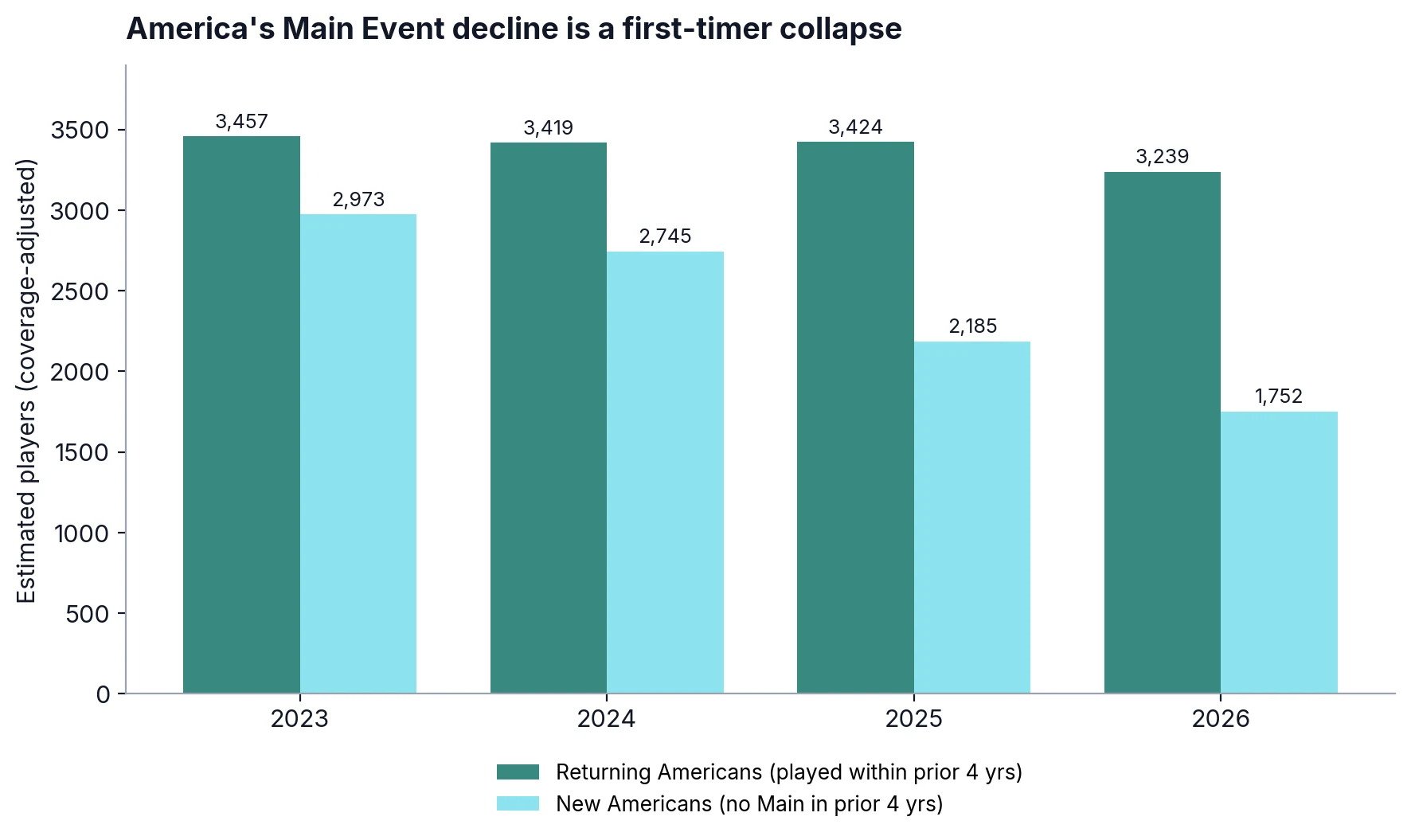
However you look at it, a 41% decline in first-time American players is a significant funnel problem. While international players face higher barriers to entry—travel is more expensive and far more time-consuming—Americans remain the lowest-hanging fruit for Main Event growth. New players are a critical part of the event's long-term health. They replace the attrition that naturally occurs in any player population, and sustained growth requires a steady stream of new players that outpaces those inevitable losses.
In 2026, a new issue emerged: the returning player base began to shrink. Returning Americans fell 5%—the first meaningful decline in the loyal cohort. But this isn't surprising. When new-player inflow dries up for three straight years, there's nothing replenishing the returning pool, and eventually that erosion reaches the regulars themselves.
The Pipeline Nobody Rebuilt
The part of the story that I think matters most started twenty-three years ago.
In my view, the 2003 boom was never really about poker on TV. It was about opportunity on TV. Chris Moneymaker was an unknown with $86 and some ability, and the satellite path turned him into a millionaire with a famous name — the purest version of a dream that America sells better than anyone. The broadcast sold the dream; the satellite sold the ticket. Millions of Americans watched, and — critically — any of them could open a poker site on their computer and take the same shot for less than a hundred bucks.
The second half is seemingly forgotten in the current equation. Black Friday killed the universal American qualification path in 2011, and it never came back for most of the country. Online poker is legal in a handful of states; for everyone else, there is no cheap on-ramp to the Main Event. The dream-selling machine still exists — it's just been rebuilt to serve everyone except the host country.
The numbers, from the most fully documented year (2024):
-
The international path. GGPoker's Road to Vegas satellites awarded 732 Main Event packages, with 59 more through its Ontario site — each package worth $12,000, buy-in plus travel.
-
The American path. WSOP.com's online satellites, the main regulated route, awarded roughly 400 seats (per Pokerfuse, February 2025), plus about 100 through ClubGG, GG's sweepstakes-model US workaround.
-
How far the American path reaches. WSOP.com operates in just four states — Michigan, Nevada, New Jersey, and Pennsylvania — covering roughly a tenth of the US population.
-
The split. Pokerfuse estimates ~15% of the 10,112-entry field arrived via online qualification. Set against the disclosed seat counts, that lands at roughly 1,000+ seats for international players against ~500 accessible to Americans.
Per player, an international entrant was about three times as likely to have arrived through an online qualifier — often operator-subsidized, while the host nation's players pay full freight.
I'm not claiming bad intent or saying GG built this on purpose — GG legally cannot operate its dot-com site in the US, and ClubGG and WSOP.com are the lawful workarounds. I also can't trace individual qualifiers in the data; the seat counts are external, the composition shifts are calculated, and the connection is correlation with a plausible mechanism, not a proven chain. But the structure is what it is: since NSUS acquired the WSOP, the event's owner profits from a qualification pipeline its host nation's players are largely locked out of, the root cause is US state-by-state regulation, and the field data shifts in exactly the direction the pipeline feeds. The international first-timer classes surged through 2023–25 — concentrated in GG-stronghold markets like Japan, Brazil, and Argentina — precisely while the American classes collapsed.
The broadcast side tells a similar story. This year, every bracelet event except the Main streams free on WSOP's own channels — 51 straight days of it — while the Main Event's daily coverage sits on the ESPN App at up to $29.99 a month until the final table hits cable (PokerNews documented the fan backlash in July). Meanwhile Winamax, an official WSOP partner, carries daily Main Event coverage free on YouTube in France. A poker fan in Paris watches the Main Event free; a poker fan in Paris, Texas pays up to $29.99 a month. France, with a free broadcast pipeline and a healthy satellite ecosystem, added more Main Event players over the window than any country on Earth except Japan — a statistical tie — and hit its all-time high in 2026. The countries with functioning pipelines are the countries growing.
American players put in an estimated ~46,400 Main Event entries from 2018 to 2026 — roughly $464 million in buy-ins — while being the one major player population excluded from the discounted qualification path and now paywalled out of coverage other markets get free. They represent the majority of the player pool across the window analyzed, and one may fairly wonder how the WSOP plans to address this evident imbalance.
I'm skeptical of ESPN's return producing a paradigm shift that brings in new American players. They seem to be re-running the 2003 playbook, and in my view that playbook worked because the broadcast had a real conversion mechanism attached to it — a universal, cheap path from couch to felt in the form of the inexpensive online satellite. That path no longer exists for roughly 90% of Americans. Storytelling without the opportunity is nostalgia marketing to the already-converted, on a network the under-40 audience largely left. The pipeline the broadcast is implicitly supposed to refill is the exact one this dataset shows collapsing 41% in three years.
The Class of 2023
There's a second question buried in the first-timer collapse: what happened to the first-timers we did get? The 2023 Main Event drew the biggest American first-timer class of the window. Where did they go?
The 2021 American class returned at a rate of 39.2% within three years. The 2022 class: 37.3%. The 2023 class — the biggest first-timer cohort of them all — returned at a rate of just 32.3%. The largest cohort of new American players the modern Main has ever attracted also came back at the lowest rate.
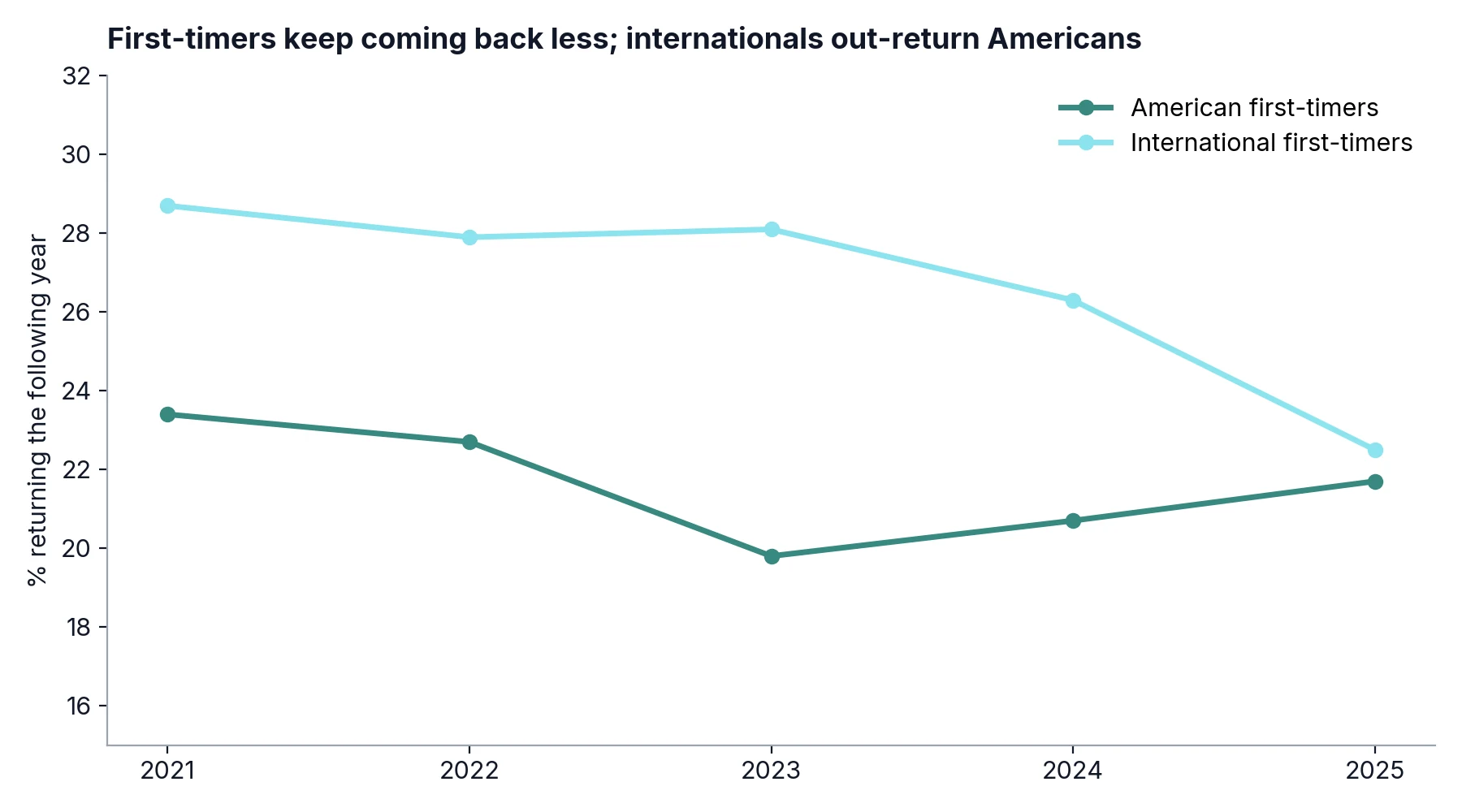
The chart plots one-year return rates — the only checkpoint every class from 2021 through 2025 has reached. The three-year figures quoted above are a different, longer checkpoint, available only for the 2021–2023 classes.
Here's my own interpretation: bucket-list demand is a stock, not a flow. Decades of "someday I'll play the Main" accumulated in the American poker population like a balance, and the 2023–24 spike drew that balance down at a record rate. A one-time withdrawal looks exactly like growth while it's happening. Then the account is lighter, and the years after inherit the empty space where the "someday" players would have been.
The Field That Remains
Subtract a collapsing first-timer class from a stable base of regulars and the math forces a conclusion: the field that remains is more experienced, more international, and harder to beat than the fields the bucket-listers walked into. Every measurable behavior in the dataset shows the same signature. The facts, briefly:
-
Experience predicts survival. Day 2 is the Main Event's real filter — roughly half the field busts during it. First-timers bag Day 2 at 45.1%; players with one prior Main at 48.6%; veterans with four or more at 51.8%.
-
The gap in one stat: American first-timers bag Day 2 at 43.3%. International veterans with 4+ Mains bag at 53.2%. That's a ten-point spread between the group that's disappearing and the group the field is shifting toward.
-
Internationals out-bag Americans every single year — by about three points, pooled across 2022–2026. The remaining field outlasts; the data can't separate skill from stack position, so I won't claim it outplays. But it survives.
-
The regulars' share is surging. Hard-core American regulars — players who'd played at least three of the prior four Series — went from 18.1% of the American field in 2022 to 28.1% in 2026. Not because regulars multiplied; because everyone else stopped showing up around them.
-
It's becoming a reunion. Nearly half the 2026 field (46.9% of Americans, 45.4% of internationals) also played in 2025.
Other Explanations Worth Considering
I think a bit of skepticism is fair and healthy, so I considered some other explanations, and what the data says about each.
"International players just show up when the dollar is weak. This is about exchange rates, not behavior."
This is probably the most common explanation for swings in international attendance, but the data doesn't support it. Japan is the clearest counterexample: over the period studied, the $10,000 buy-in became 47% more expensive in yen, yet Japanese attendance nearly quadrupled anyway. Europe is mixed at best. The euro's cheapest buy-in year (2025) did coincide with the international attendance peak, but the euro remained relatively strong in 2026 while European participation softened. And, most importantly, exchange rates can't explain the central finding at all: the decline in American attendance.
"It's just normalization after the COVID spike."
This is partly true—for the overall field. The 2026 Main Event drew 9,208 players, still 7.5% more than in 2019. In that sense, the "decline" exists only relative to the extraordinary surge in 2023 and 2024.
But if this were simply a return to normal, you would expect both halves of the field to fall back in roughly the same proportions. That's not what happened. Compared with 2019, American attendance is down 5.4%, while international attendance is up 35%. Normalization explains the shape of the total field. It does not explain the composition of that field changing so dramatically.
"The Main Event just got too expensive."
The buy-in has been $10,000 since 1972. Adjusted for inflation, the 2026 Main Event is the least expensive it has ever been. Whatever is discouraging new American players, it isn't the sticker price.
None of these explanations address the central finding: by 2026, the US field was nearly 1,000 players smaller than it was at its 2023 peak, while international first-time players continued returning at consistently higher rates than their American counterparts.
The Number to Watch
Tonight the final table hits ESPN2, and the broadcast will do what broadcasts do best: sell the dream to whoever is watching.
American Main Event attendance flatlined from 2018 to 2026, spiked in 2023, and has given the spike back — down 15% from the peak — while the field's US share fell from 70% to 59%. The decline is not regulars quitting; it's new-player inflow collapsing 41% in three years, with the biggest first-timer class in the event's modern history returning at the lowest rate ever measured. The field that remains is older in tenure, more international, and it outlasts.
The next two Series will tell us which story this is. If the 2023 spike simply pulled the bucket-listers forward, new American inflow should level off by 2027 or 2028 on its own. If it keeps falling past that, the problem isn't the spike — it's the pipeline, and no amount of story-driven programming fixes a path that roughly 90% of Americans can't take. That makes the 2027 first-timer number the single most interesting stat in poker, and I'll be counting.
Full methodology, country tables, sources, and the data tables: WSOP Main Event attendance: methods and data.